Picture a blue dawn nibbling at the blackness as the thermometer continue to drop. The morning turns a rich Cornell blue, a distant blue I named after Joseph Cornell the collagist I imitated for years.
Picture the lapis fog hugging the vague and luminous morning, pulling it near.
Picture a fog so thick the wipers scrape it off the windshield like lightly falling snow.
Picture the illustrious blue fading as the day brightens, whitens.
Picture the bruised apple brown of the big leafed maples;
the speckled towers of Lombardy poplars;
the edible red of Virginia creeper spilling down the barrier walls on the freeway as I race by.
Picture the blues far behind me.
Tuesday, October 26, 2010
Sunday, October 17, 2010
SPRING IS NEAR
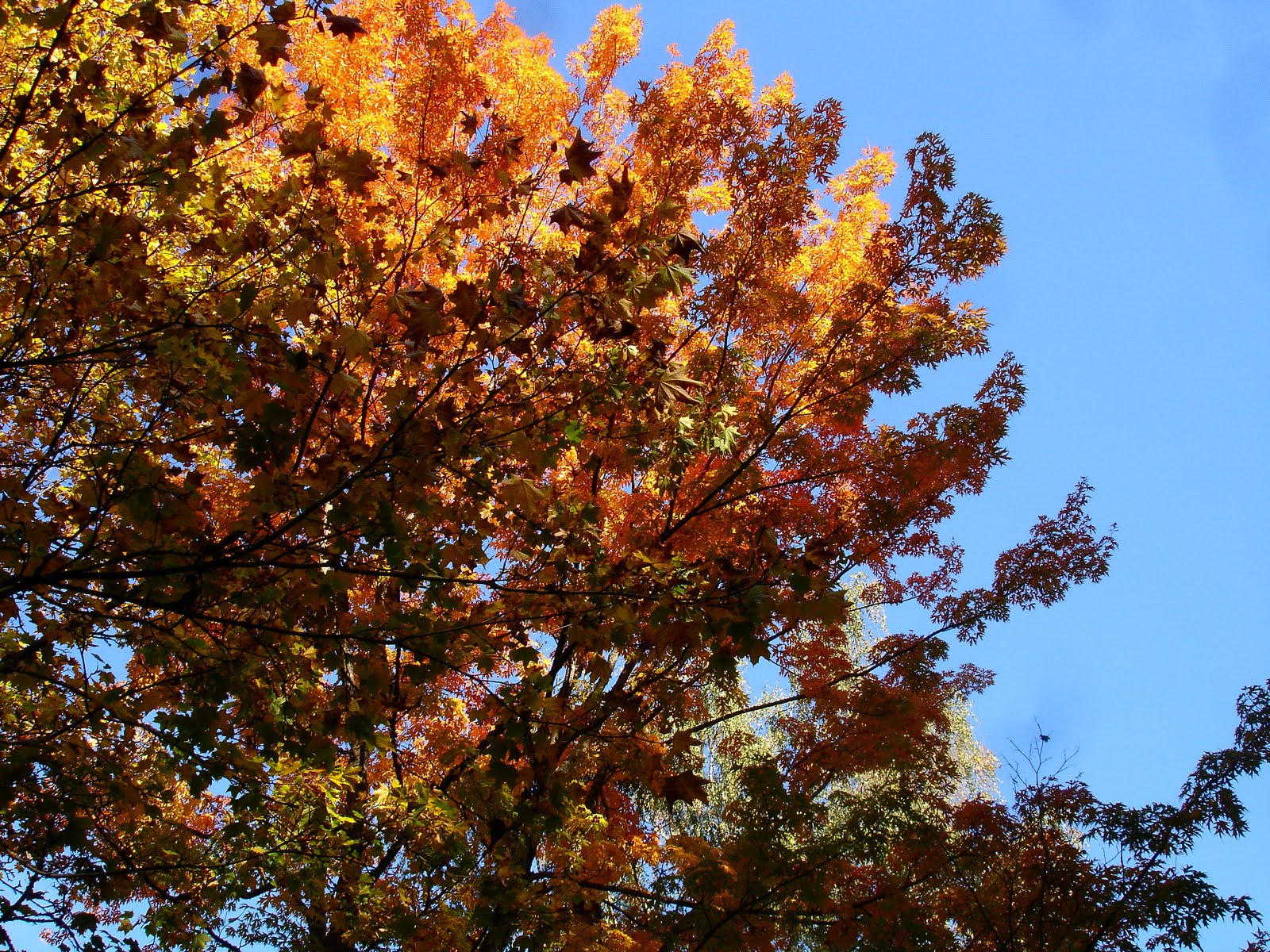
I know the orange assault of the sugar maple has only begun, but I can’t help but think of spring. I’m planting bulbs this weekend. And just the other day when I entered the greenhouses a Molbak’s Farm I was overwhelmed by the scent of violets, the sweet elusive fragrance vanished quickly. But not it’s impact. I was standing in a house full of warm sunshine and 1000s of winter pansies. It didn’t smell like fall at all. No crisp vinegar of rotting apples, no burnt sugar of katsura, or marigolds’ persistent pungency. It was the sweet scent of spring. Or the faux spring of my youth when I visited the temperate dome at the Mitchell Park Conservatory around Valentine’s Day. The streets outside would be crusted with months of old snow, but inside newly planted and replete with pansies and bulbs we got a glimpse of spring.
I grew up in a place where winter pansy was an oxymoron. So when I arrived in Seattle 22 years ago and saw pansies for sale at the grocery store in November I was shocked.
Shocked and delighted. I love pansies. My excitement about moving to the Northwest trebled as I put the little blue 4” pansy into my shopping cart. Yet I was both doubtful and hopeful.

Until a few months later when the north winds flew in with fists, like a master boxer, flattening my winter pansy. Down for the count, I had little hope and abundant doubts about winter pansies. Yet with the first warmish days of February it was up again. It was perched so carelessly on the window ledge, god knows I was doing nothing to help it along. I am a cruel lover.
Then a February snow floated in like a butterfly and stung like a bee, taking the wind out of my hopes completely. My little blue pansy, I had chosen “Crystal Bowl True Blue” for it’s stunningly icy purity, lied bruised and prostate over the edge of the pot.
Not all pansies are winter pansies. Maybe I had been duped?
Most pansies fitting into the inter specific hybrid Viola x wittrockiana, named after the Swedish botanist V.B. Wittrock who studied them extensively, are the progeny of three european species. V. tricolor, V. lutea and V. alaica. The enthusiastic hybridizing which began in England in the 1820s, made pansies one of the most popular annuals.
Though botanically speaking all pansies are Violas, not all violas are pansies. Some sources say the difference lies in fragrance, pansies have it and violas don’t , carrying more genetic information from the scentless V. tricolor. Another source says that pansies have a black velvety splotch in the middle where as violas don’t. I asked a friend at Wells Medina Nursery, who said, “We call the little ones violas and the big ones pansies.”
“ A rose by any other name...” I replied.

Nomenclature and botany aside, I love them all. And their persistent popularity, almost 2 centuries, is proof that I am not alone. With over 70 names in English they have endeared people as much as dogs or cats. Of these names “pansy” , from the French pensee meaning “thoughts”, seems to have stuck. Thought, one author speculates, because it is “ the noblest faculty with which mankind is gifted”. My Aunt Lottie had her own take on it, she found their pinched little faces charming aggravated with thought. “Heart’s-ease”, a name that appears as often in older literature speaks to the calming effects of the fragrance and it’s attribution to Saint Valentine. And I must admit they do do something to my heart that feels quite a bit like ease.
By April of my first year here, my seemingly limp-wristed pansy, like the effeminate boys it lends its name to, proved to be tough. Came out swinging. As winter was lead from the ring, my little winter pansy was crowned with a victor’s bouquet of blue. This same triumphant nature has inspired British artist Paul Harfleet to develop The Pansy Project, an ongoing installation to bring awareness to homophobic abuse.
And to spread the love of pansies. Sometimes as orange as maples

Sunday, October 10, 2010
TAKE ME HIGHER
Last Sunday we left our home at 65 feet above sea level to go hiking near Mount Rainier. It was Michael’s birthday, actually the day before, and he just wanted to “get away”.
We headed out of the fog belt early, or so we thought. By the time we had reached the gate of the park our hopes of seeing the mountain were pretty slim. Even the ranger who greeted us as we entered said, “You won’t see the mountain today.” We decided to drive up to the trailhead at Sunrise anyway. At times we were totally encased in clouds. Yet when we reached Sunrise and the lodge at 6385 feet, the day broke all its dreary promises and showed us blue skies and a magnificent view of the north side of Mount Rainier.

The clouds had not really broke, they lurched and eddied below us in the valley. We had risen above them. The lodge had already closed for the season and the normal crowds were absent from the parking lots and trails at Sunrise. We planned only a small hike, but it kept expanding as we enter this incredible landscape. Humbled hikers coming down, dumbfounded by the beauty said simple things like; “ Great view.”; “It’s worth the trip.”; or “It’s beautiful up there.”
We hiked through the alpine meadows and clusters of alpine firs(Abies lasciocarpa). Up on to the tundra covered lava flow of Burroughs Mountain.

Though I knew it was beautiful up there I also could not stop seeing the beauty all around. I would have been just as happy, or so I say now, if the mountain had not shown itself and our view had been limited to the statuesque heights of the white barked pines (Pinus albicaulis), to the flushes of huckleberries, blueberries and mountain ash turning fiery hues. I would have been happy with lichen speckled rocks, seed heads and chipmunks. Yet the shear mass of the volcano drew us on. I stopped as often as possible, though, to take snap shots along the way. The details were so engrossing. I love the details. “God’s in the details,” it's sais. But who said? Descartes? Henry Ford?

Michael was getting a bit perturbed with me stopping to snap at a wild flower, a picturesque view, or a portrait of him. “Why can’t a hike just be a hike?” he harumphed. I told him, “Don’t stop for me; I’ll catch up.” But he has some inbred politeness, akin to my inbred acquisitiveness, which makes him stop and wait. Which makes me hurry up, feeling like the “ol’ ball and chain” again. I understand that a goal is set, but I’m a dallier. I like to botanize, take a photo, watch a bird through the binoculars.
Why am I so unsatisfied with the 2 lenses God gave me? I have excellent eye site, at least at a distance, reading glasses are a necessity though. Why do I need to capture with the little lens of my camera, my little ineffectual camera in the face of such grandeur, any of this? Why must I zoom ahead of my steps with the binoculars? Go beyond where I am to over there, way over there, to catch some detail I could catch with the bare eye? When at my feet the detail is rich and rewarding?
I even questioned my eyes and their exquisite lenses, 52 year old lenses still penetrating the visual world with acuity and speed. Soaring miles across the landscape, or hunkering down into saxifrages clutching at rocks. Here I was in front of this sprawling view of the mountain and all I could do was see it. I wondered about an internal lens, a way of perception beyond seeing. Or a way of seeing beyond perception. I am only speculating here, but I imagine that lens is what some people call the soul. This huge polished convex existence I call me, facing the world, both absorbing and reflecting it.

Then a clutter of alpine birds skittered over the pumice strewn moonscape of Burroughs Mountain and I went for my binoculars as a hunter would a gun. The birds didn’t pause very long, the binoculars were useless. If I would have watched them with my eyes what sort of flighty dance would I have seen? What wealth of detail is required by the casual observer? If I had stopped opened some magical internal lens of my imaginings, what would I have seen? The swirl of the cosmos wrapped in gray feathers? Or just birds being birds?

Michael had already reached the summit, “ the very end of the world” as he called it. I had to catch up. My questions became as cumbersome as cameras and binoculars, and my ever acquisitive eyes.

At 7400 feet I joined him for an apple on a rock above a gaping white sea of clouds below and the incomprehensible mountain above. The mountain rumbled with avalanches. I was covered with awe like a blanket, like blindness though I could see.
I could see.

The winds shifted and the clouds began moving up the flanks of the mountain. As we hiked down the clouds swaddled the trail. Forced us back into the human scale world of conifers rocks, and alpine perennials. The flowering was over, yet the spectacle of regeneration plumed the alpine meadows with seeds. I stopped again and again as I tend to do. Maybe Michael was getting tired, he stopped more too. Maybe he was beginning to enjoy the little pauses these stops prompted. Maybe he was beginning to appreciate a chance to dally as much as I appreciate him driving us on.
And driving us home through some of the densest fogs I’ve seen.
We headed out of the fog belt early, or so we thought. By the time we had reached the gate of the park our hopes of seeing the mountain were pretty slim. Even the ranger who greeted us as we entered said, “You won’t see the mountain today.” We decided to drive up to the trailhead at Sunrise anyway. At times we were totally encased in clouds. Yet when we reached Sunrise and the lodge at 6385 feet, the day broke all its dreary promises and showed us blue skies and a magnificent view of the north side of Mount Rainier.

The clouds had not really broke, they lurched and eddied below us in the valley. We had risen above them. The lodge had already closed for the season and the normal crowds were absent from the parking lots and trails at Sunrise. We planned only a small hike, but it kept expanding as we enter this incredible landscape. Humbled hikers coming down, dumbfounded by the beauty said simple things like; “ Great view.”; “It’s worth the trip.”; or “It’s beautiful up there.”
We hiked through the alpine meadows and clusters of alpine firs(Abies lasciocarpa). Up on to the tundra covered lava flow of Burroughs Mountain.

Though I knew it was beautiful up there I also could not stop seeing the beauty all around. I would have been just as happy, or so I say now, if the mountain had not shown itself and our view had been limited to the statuesque heights of the white barked pines (Pinus albicaulis), to the flushes of huckleberries, blueberries and mountain ash turning fiery hues. I would have been happy with lichen speckled rocks, seed heads and chipmunks. Yet the shear mass of the volcano drew us on. I stopped as often as possible, though, to take snap shots along the way. The details were so engrossing. I love the details. “God’s in the details,” it's sais. But who said? Descartes? Henry Ford?

Michael was getting a bit perturbed with me stopping to snap at a wild flower, a picturesque view, or a portrait of him. “Why can’t a hike just be a hike?” he harumphed. I told him, “Don’t stop for me; I’ll catch up.” But he has some inbred politeness, akin to my inbred acquisitiveness, which makes him stop and wait. Which makes me hurry up, feeling like the “ol’ ball and chain” again. I understand that a goal is set, but I’m a dallier. I like to botanize, take a photo, watch a bird through the binoculars.
Why am I so unsatisfied with the 2 lenses God gave me? I have excellent eye site, at least at a distance, reading glasses are a necessity though. Why do I need to capture with the little lens of my camera, my little ineffectual camera in the face of such grandeur, any of this? Why must I zoom ahead of my steps with the binoculars? Go beyond where I am to over there, way over there, to catch some detail I could catch with the bare eye? When at my feet the detail is rich and rewarding?
I even questioned my eyes and their exquisite lenses, 52 year old lenses still penetrating the visual world with acuity and speed. Soaring miles across the landscape, or hunkering down into saxifrages clutching at rocks. Here I was in front of this sprawling view of the mountain and all I could do was see it. I wondered about an internal lens, a way of perception beyond seeing. Or a way of seeing beyond perception. I am only speculating here, but I imagine that lens is what some people call the soul. This huge polished convex existence I call me, facing the world, both absorbing and reflecting it.

Then a clutter of alpine birds skittered over the pumice strewn moonscape of Burroughs Mountain and I went for my binoculars as a hunter would a gun. The birds didn’t pause very long, the binoculars were useless. If I would have watched them with my eyes what sort of flighty dance would I have seen? What wealth of detail is required by the casual observer? If I had stopped opened some magical internal lens of my imaginings, what would I have seen? The swirl of the cosmos wrapped in gray feathers? Or just birds being birds?

Michael had already reached the summit, “ the very end of the world” as he called it. I had to catch up. My questions became as cumbersome as cameras and binoculars, and my ever acquisitive eyes.

At 7400 feet I joined him for an apple on a rock above a gaping white sea of clouds below and the incomprehensible mountain above. The mountain rumbled with avalanches. I was covered with awe like a blanket, like blindness though I could see.
I could see.

The winds shifted and the clouds began moving up the flanks of the mountain. As we hiked down the clouds swaddled the trail. Forced us back into the human scale world of conifers rocks, and alpine perennials. The flowering was over, yet the spectacle of regeneration plumed the alpine meadows with seeds. I stopped again and again as I tend to do. Maybe Michael was getting tired, he stopped more too. Maybe he was beginning to enjoy the little pauses these stops prompted. Maybe he was beginning to appreciate a chance to dally as much as I appreciate him driving us on.
And driving us home through some of the densest fogs I’ve seen.
Saturday, October 2, 2010
EXHAUSTED
I thought I had exhausted the nursery possibilities here in the Northwest. Maybe I was exhausted, gave up the hunt for something new. I stopped going to plant sales, started doing more mail order. Dragged seed back from Italy, Turkey and Wisconsin.
Yes, Wisconsin.
I’m getting older, becoming more motivated by nostalgia than innovation. Last month, I traveled with glee through my home state which I loathed with a premeditated boredom just years ago, over 25 now. Having firmly and irreversibly moved away, and as I said, having grown older and more nostalgic, I find Wisconsin a delightful place. Its rather lackadaisical - you must realize I live with a view to the rather dramatic tectonic uplift of the Cascades - landscape has a loveliness akin to Central Europe or England. As we drove through rolling farm land, the shear agronomic force of the state made us hungry. And Wisconsinites, my family among them, have a propensity toward eating. As we drove by wagon loads of melons, squash and sweet corn I begrudged our road trip which did not always involve a kitchen at the end of the day.Though we did mange a stop at a cheese factory for “squeeky” cheese.
But Michael and I were not on a culinary foray, but a horticultural one. When I lived in Wisconsin, it’s where I studied botany, I rarely found time for gardens. I was in the woods or in a bar, or the library. I had not quite seen my future as a gardener. Though there were gardeners all around me and I always managed to find the 3 square feet of bare dirt behind any apartment I lived in to fill with a tomato plant or sunflowers, I still did not consider myself a gardener. Even to this day I have a shrug-it-off reluctance to calling myself a gardener, though I garden continually. And when not gardening I am writing about gardening.
So Wisconsin had many surprises for us with it’s many interesting and regionally driven gardens. As we toured around I began to realize a whole host of my favorite plants either come form there or perform better there than in the timid climate of the Pacific Northwest. I am especially fond of prairie plants. Liatris, black eyed susans, tall blue-stem, golden rod. I have tried to use them in the gardens I create here, but eventually they succumb to the dry summers or a warm wet winter. These plants were made to thrive in a harsh climate. Only in rare pockets of the Northwest have I seen the prairie style of gardening succeed. Yet there even the weedy roadsides looked like grand mixed borders and European weeds like Queen Anne’s lace, day lilies and sow thistle wriggled into the mix as if guided by a designing hand.
One of the few prairie plants I have had success with in the Northwest is the black-eyed susan (Rudbeckia ssp.) Their outlandish color, though hard to mix, and stalwart nature has made them nearly ubiquitous at this point. Yet I never tire of this ubiquity especially at this time of year when doses of strong color assuage any melancholy brought on by the encroaching gray.

I was captivated by the height and pinwheel-like flowers of the sweet black-eyed susan named ‘Henry Eilers’ (Rudbeckia subtomentosa), when I saw it at Northwind Perennial Farm. With the impulse of a neophyte I bought one, along with compass flower (Silphium lanciniatum) and deer-tongued grass (Dicanthelium clandestinum).


In the display gardens at Northwind it was obviously late summer. The dramatic sweeps of grasses, both native and exotic with a mix of shrubs and flowering perennials were already crashing from excessive rains, drought and high winds. But his chaos was beautiful and strangely restful compared to the more dramatic annual plantings elsewhere.

Although I was glad we stopped at the Rotary Botanical Gardens in Janesville. The outrageously unexpected red and black borders surrounding the parking were stunning.


At the Olbrich Garden in Madison grasses were used through out, as architecturally as conifers or furniture.

The exotic Japanese fountain grass (Pennisetum alopecuroides) and Japanese silver grass ( Miscanthus cv.) frame a ‘Golden Globe’ arborvitae (Thuja occidentalis- a Wisconsin native).

The Monarchs were leaving in great feeding flocks, if that is what butterflies travel in. And we, too, had to travel.
I borrowed a suitcase from my sister to pack all the plants I was bringing back. Who did I think I was? Dan Hinkley? Was I trying to retrieve a past I never truly appreciated? Or experienced? I had dug 3 black spruce (Picea mariana) from my parents farm. Was I trying to transplant the great northern forests that cover Canada to the Snoqulamie Valley? Or was I truly just experimenting with a tree that I've grown calmly and slowly fond of? I dug a piece of my mother’s fern leaf peony (Paeonia tenuifolia ‘Rubra Flora Plena’??) which I knew I could getback in Seattle, but it wouldn’t be from my mother’s garden. But when I saw the ‘Henry Eilers’ rudbeckia at the Northwest Horticultural Society’s plant sale ,where I bought even more plants, I realized maybe my search of Northwest nurseries was not as exhaustive as I thought. Maybe I am just suffering from the exhaustion of acquisition. But I know when that rudbeckia blooms and reminds me of a September day in rural Wisconsin, I will have forgotten the $15 dollars i spent on that extra peice of luggage and remeber a Septenber day in rural Wisconsin.
Yes, Wisconsin.
I’m getting older, becoming more motivated by nostalgia than innovation. Last month, I traveled with glee through my home state which I loathed with a premeditated boredom just years ago, over 25 now. Having firmly and irreversibly moved away, and as I said, having grown older and more nostalgic, I find Wisconsin a delightful place. Its rather lackadaisical - you must realize I live with a view to the rather dramatic tectonic uplift of the Cascades - landscape has a loveliness akin to Central Europe or England. As we drove through rolling farm land, the shear agronomic force of the state made us hungry. And Wisconsinites, my family among them, have a propensity toward eating. As we drove by wagon loads of melons, squash and sweet corn I begrudged our road trip which did not always involve a kitchen at the end of the day.Though we did mange a stop at a cheese factory for “squeeky” cheese.
But Michael and I were not on a culinary foray, but a horticultural one. When I lived in Wisconsin, it’s where I studied botany, I rarely found time for gardens. I was in the woods or in a bar, or the library. I had not quite seen my future as a gardener. Though there were gardeners all around me and I always managed to find the 3 square feet of bare dirt behind any apartment I lived in to fill with a tomato plant or sunflowers, I still did not consider myself a gardener. Even to this day I have a shrug-it-off reluctance to calling myself a gardener, though I garden continually. And when not gardening I am writing about gardening.
So Wisconsin had many surprises for us with it’s many interesting and regionally driven gardens. As we toured around I began to realize a whole host of my favorite plants either come form there or perform better there than in the timid climate of the Pacific Northwest. I am especially fond of prairie plants. Liatris, black eyed susans, tall blue-stem, golden rod. I have tried to use them in the gardens I create here, but eventually they succumb to the dry summers or a warm wet winter. These plants were made to thrive in a harsh climate. Only in rare pockets of the Northwest have I seen the prairie style of gardening succeed. Yet there even the weedy roadsides looked like grand mixed borders and European weeds like Queen Anne’s lace, day lilies and sow thistle wriggled into the mix as if guided by a designing hand.
One of the few prairie plants I have had success with in the Northwest is the black-eyed susan (Rudbeckia ssp.) Their outlandish color, though hard to mix, and stalwart nature has made them nearly ubiquitous at this point. Yet I never tire of this ubiquity especially at this time of year when doses of strong color assuage any melancholy brought on by the encroaching gray.

I was captivated by the height and pinwheel-like flowers of the sweet black-eyed susan named ‘Henry Eilers’ (Rudbeckia subtomentosa), when I saw it at Northwind Perennial Farm. With the impulse of a neophyte I bought one, along with compass flower (Silphium lanciniatum) and deer-tongued grass (Dicanthelium clandestinum).


In the display gardens at Northwind it was obviously late summer. The dramatic sweeps of grasses, both native and exotic with a mix of shrubs and flowering perennials were already crashing from excessive rains, drought and high winds. But his chaos was beautiful and strangely restful compared to the more dramatic annual plantings elsewhere.

Although I was glad we stopped at the Rotary Botanical Gardens in Janesville. The outrageously unexpected red and black borders surrounding the parking were stunning.


At the Olbrich Garden in Madison grasses were used through out, as architecturally as conifers or furniture.

The exotic Japanese fountain grass (Pennisetum alopecuroides) and Japanese silver grass ( Miscanthus cv.) frame a ‘Golden Globe’ arborvitae (Thuja occidentalis- a Wisconsin native).

The Monarchs were leaving in great feeding flocks, if that is what butterflies travel in. And we, too, had to travel.
I borrowed a suitcase from my sister to pack all the plants I was bringing back. Who did I think I was? Dan Hinkley? Was I trying to retrieve a past I never truly appreciated? Or experienced? I had dug 3 black spruce (Picea mariana) from my parents farm. Was I trying to transplant the great northern forests that cover Canada to the Snoqulamie Valley? Or was I truly just experimenting with a tree that I've grown calmly and slowly fond of? I dug a piece of my mother’s fern leaf peony (Paeonia tenuifolia ‘Rubra Flora Plena’??) which I knew I could getback in Seattle, but it wouldn’t be from my mother’s garden. But when I saw the ‘Henry Eilers’ rudbeckia at the Northwest Horticultural Society’s plant sale ,where I bought even more plants, I realized maybe my search of Northwest nurseries was not as exhaustive as I thought. Maybe I am just suffering from the exhaustion of acquisition. But I know when that rudbeckia blooms and reminds me of a September day in rural Wisconsin, I will have forgotten the $15 dollars i spent on that extra peice of luggage and remeber a Septenber day in rural Wisconsin.
Sunday, September 26, 2010
WEATHER, OR NOT
If clothes make the man, weather makes the garden. No matter how clever my plantings, how thorough my care a heavy rain, a cold spring, or a hot dry spell can alter a garden in ways never intended.

A few weeks ago when I visited the Chicago Botanical Garden with my sister Julie, the winds were high the sky smudgy with clouds, making photography rather difficult and the whole visit fraught with a low level irritation. Not at all my experience there on other occasions. I didn’t like the garden. But truly I didn’t like the weather. Even though the stiff Japanese garden didn’t budge in the winds there was no tranquility to it, only resistance. The only serenity to be found that day was in the banks of ornamental grasses plowed over by the forceful winds. They had no qualms as they became the winds, which we could not.

A few days later at Taliesen the winds were more rambunctious. As Michael and I roamed the hills of this fascinating estate, we were nearly blown away. Yet Frank Lloyd Wright who grew up in this rolling landscape along the Wisconsin River, knew these winds and designed bluffs and coves of ferny stillness which were refuges on our tour.
Just a few days ago it was a weather-less day. No shadow under the thin fog, no precipitation, no wind. The fog lent a whiteness to the morning that made everything gray. Yet you could hear the sun’s rays pinging off the upper surface of the fog bank as they slowly stripped it away with seductive slowness. First the shoulder of a hill, then the moony pale inner thigh of the lake. Eventually the sun broke through and a breeze trembled through the springy boughs.
Even this little shift from morning to afternoon was a reminder of the direction we were heading.
Yes, the winds will come.
The leaves will fly.
The rains fall, and the frosts kill.
That weather-less day was the last day of summer and, paraphrasing T.S. Eliot, it ended with a whimper, not a bang.

A few weeks ago when I visited the Chicago Botanical Garden with my sister Julie, the winds were high the sky smudgy with clouds, making photography rather difficult and the whole visit fraught with a low level irritation. Not at all my experience there on other occasions. I didn’t like the garden. But truly I didn’t like the weather. Even though the stiff Japanese garden didn’t budge in the winds there was no tranquility to it, only resistance. The only serenity to be found that day was in the banks of ornamental grasses plowed over by the forceful winds. They had no qualms as they became the winds, which we could not.

A few days later at Taliesen the winds were more rambunctious. As Michael and I roamed the hills of this fascinating estate, we were nearly blown away. Yet Frank Lloyd Wright who grew up in this rolling landscape along the Wisconsin River, knew these winds and designed bluffs and coves of ferny stillness which were refuges on our tour.
Just a few days ago it was a weather-less day. No shadow under the thin fog, no precipitation, no wind. The fog lent a whiteness to the morning that made everything gray. Yet you could hear the sun’s rays pinging off the upper surface of the fog bank as they slowly stripped it away with seductive slowness. First the shoulder of a hill, then the moony pale inner thigh of the lake. Eventually the sun broke through and a breeze trembled through the springy boughs.
Even this little shift from morning to afternoon was a reminder of the direction we were heading.
Yes, the winds will come.
The leaves will fly.
The rains fall, and the frosts kill.
That weather-less day was the last day of summer and, paraphrasing T.S. Eliot, it ended with a whimper, not a bang.
Saturday, September 18, 2010
TRIP WITHIN A TRIP
Sometimes I am so frustrated by blogging that I want to quit. No time has this been more true than this morning when I sat down to post about my recent trip to Wisconsin and the Upper Peninsula of Michigan. It seems all I can share is snippets and snap shots. I can not pour the familiar humid fragrance of late summer in Milwaukee through cyberspace. Nor can I capture the warblings of warblers in Estebrook Park, or the crack of wind in leaves. Nor the subtle changes of temperature through out the day. The blast of hail, the crack and blitz of lightening and thunder. Nor the bite and sugar of a vine ripe Big Boy tomato sliced thick and big enough to cover a whole slice of toast slathered with mayonaise.
I can not capture the miles traveled to family visits, gardens explored and natural wonders touched. But one trip with n the bigger trip I cannot avoid writing about.
Michael had never seen Lake Superior, so when we were visiting my parents on their farm in the Iron River we decided to take a day trip north.


Our first stop at Canyon Falls on the Sturgeon River was a revelation. What the guide book calls the “Grand Canyon of Michigan” is only 300 feet deep at it’s deepest farther north from where we stopped. Yet the twists and turns of the river through the forest as it headed into the canyon were lovely.
Our goal was Point Abbaye an un-populated cape just east of the town of L’Anse. The road in had my father perpetually asking “Where are we going?” Michael jokingly responded, “To the end of the world.” I was beginning to wonder myself if we were headed toward the end of the world as the gravel road narrowed, got muddier and offered only scant views of the the lake through the dense forest. We wondered if we had made the right choice, but there was no place to turn the car around, so on we went.


We were not disappointed when we finally reached our goal. The sand stone shelf flaked and eroded by wind and water at the tip of the cape was picturesque and offered great views of the Huron Islands and the Huron Mountains to the south.

Michael walked right out to the very end of the world.


While I got into the details of the place.
We only saw a snippet of the lake, a hint of it’s vastness. Lake Superior, the third largest body of fresh water in the world has the largest surface area of any, 31,820 square miles and contains over 2904 square miles of water. It’s a cold lake with and average summer temperature of 40 degrees and the deepest of the Great Lakes at 1332 feet, give or take and inch.
The wind swept point was densely forested nearly to the shore and with a surprising number of very large trees that I though should have succumbed to the horrific winter storms that cross the lake.

My parents posed for me in front of the largest red maple (Acer rubrum) I’ve ever seen. Even though I had visited many gardens, the Chicago Botanical Garden, Olbrich Garden in Madison, the wonderful Northwind Perennial Nursery and Taliesen, Frank Lloyd Wright's school and home in Spring Green, WI on this trip, nothing could match the beauty of this little forlorned cape jutting proudly, silently into the vastness of Lake Superior. And a brisk and summy day spent with my parents and Michael.
I can not capture the miles traveled to family visits, gardens explored and natural wonders touched. But one trip with n the bigger trip I cannot avoid writing about.
Michael had never seen Lake Superior, so when we were visiting my parents on their farm in the Iron River we decided to take a day trip north.


Our first stop at Canyon Falls on the Sturgeon River was a revelation. What the guide book calls the “Grand Canyon of Michigan” is only 300 feet deep at it’s deepest farther north from where we stopped. Yet the twists and turns of the river through the forest as it headed into the canyon were lovely.
Our goal was Point Abbaye an un-populated cape just east of the town of L’Anse. The road in had my father perpetually asking “Where are we going?” Michael jokingly responded, “To the end of the world.” I was beginning to wonder myself if we were headed toward the end of the world as the gravel road narrowed, got muddier and offered only scant views of the the lake through the dense forest. We wondered if we had made the right choice, but there was no place to turn the car around, so on we went.


We were not disappointed when we finally reached our goal. The sand stone shelf flaked and eroded by wind and water at the tip of the cape was picturesque and offered great views of the Huron Islands and the Huron Mountains to the south.

Michael walked right out to the very end of the world.


While I got into the details of the place.
We only saw a snippet of the lake, a hint of it’s vastness. Lake Superior, the third largest body of fresh water in the world has the largest surface area of any, 31,820 square miles and contains over 2904 square miles of water. It’s a cold lake with and average summer temperature of 40 degrees and the deepest of the Great Lakes at 1332 feet, give or take and inch.
The wind swept point was densely forested nearly to the shore and with a surprising number of very large trees that I though should have succumbed to the horrific winter storms that cross the lake.

My parents posed for me in front of the largest red maple (Acer rubrum) I’ve ever seen. Even though I had visited many gardens, the Chicago Botanical Garden, Olbrich Garden in Madison, the wonderful Northwind Perennial Nursery and Taliesen, Frank Lloyd Wright's school and home in Spring Green, WI on this trip, nothing could match the beauty of this little forlorned cape jutting proudly, silently into the vastness of Lake Superior. And a brisk and summy day spent with my parents and Michael.
Tuesday, August 31, 2010
COLD COMFORT

A rainy chilly morning once again dispelling any sense of summer. At least summer as I like to think of it, blistering hot, cucumber-laden, shade-seeking summer. At least the rain keeps the pools of fog out of the valley. I have a gothicky side that loves a blinding fog. But this time of year when the fogs start settling in it can mean death for our tomatoes. Already the chilly nights dipping into the 40’s--- for chrissake, it’s August!---has slowed the already sluggish ripening process.
I started to look for green tomato recipes, but the ever-optimistic Michael told me to “hold my horses”. His faith in a tomato-y future, a red ripe tomato-y future seems futile to me. But who am I to question faith? Or complain about a Northwest summer that is truly not that far from normal?
But you can’t eat 4-leafed clovers. Well, I guess you can. You might even be able to make some sort of pesto out of them. Hmmm.
Yet there is always one green thing that is ripe and ready. Cabbage. It’s no wonder they are a constant in Northern European cuisine. We had cabbage last year when summer was sweltering and we have cabbage this year when summer is faltering. Beyond my seasonal pinings for sauerkraut, I love the pallid sulfurous crunch cabbage lends to fish tacos, I even eat the slightly wilted and greasy bed of it that comes under the egg rolls in our favorite Vietnamese restaurant Tamarind Tree.
Cabbage is comfort food for me. Other people might like their loaf of bread, their potatoes, their 5 o’clock cocktail. For me it’s cabbage. Even before I was farming I always had a head of cabbage in the crisper. It’s exactly this storability which puts me at ease. We leave them in the field nearly until Christmas if we don’t get a frost. Or we hang them upside down roots and all in the basement, where they last until spring. Actually one started growing again to our amazement.
So when my flimsy faith in a red tomato-y future wanes I take precious comfort in our rows of cabbages, benign and beneficent. If there won’t be spaghetti sauce there will at least be potagers.
Yet, I can’t help but hopefully turn up the cucumber leaves in my search for supplies to fuel one of my greatest summer pleasures, pickling. This year I managed to squeeze out 4 quarts of pickles. Not a lot I know but come December, a guaranteed triumph over winter and grocery store prices.

I have been driving Michael crazy with my obsession with heirloom vegetables with Wisconsin place names. After the year we tried “Pride of Wisconsin’ cantaloupe and it barely made it to boasting, he’s been suspect. But his good nature and scientific inquisitiveness always lets me experiment.
So this year it was ‘Sheboygan’ paste tomatoes. Named after the foggy city on the shores of Lake Michigan I thought they might have a chance here. Actually they’ve proven to be the only tomatoes to ripen for us so far this year. Don’t forget we have a red tomato-y future ahead. They are a lovely pink and have a delightful sweet flesh. We will definitely grow this one again.

The cucumber ‘Wautoma’ named after the Central Wisconsin city famous for pickle production, Wisconsin ranks 4th in US pickle production, has not been extremely generous, how could it be with nights dipping in to the 40s. But the gherkins it did produce were, crispy and flavorful with a a dark green skin making a beautiful pickle.
Since I am off to Wisconsin tomorrow, I’m afraid I might miss that one red tomato which the future promises. Or the 3 cucumbers which are smaller than the slugs, granted we have very large slugs and a few too many this year, inching their way to completion. But I know I can take comfort in the fact that when we return in 2 weeks there will be cabbage. Not just one cabbage, but months worth of cabbage, ripe and green and ready for the picking.
Subscribe to:
Posts (Atom)