Sunday, January 30, 2011

THE MOUNTAIN TOP


In January, as all the hope and sparkle of Christmas is stripped away, when we are left finally with what we’ve been avoiding: Winter, is when they begin to appear. Tropical Beaches. They appear on billboards and in magazines, on the sides of buses. Palm trees, blue waters and sunshine, everything we feel we are lacking.
So when I arrived in Milwaukee at the beginning of the coldest month of the whole winter, my sister was laughing, “ Why did you come to Wisconsin in January?”
I fished through my thoughts: “Cheap airfares?”; “ Work was slow, it was a good time to get away?”.
Actually I wanted to visit my parents at a time of year when they rarely get visitors. The Upper Peninsula of Michigan, or the U.P. as it is fondly known, isn’t much of a draw unless you like ice fishing or snowmobiling, neither of which were in my plans.
I love winter, real wintery winter, it must be encoded in my nordic genes. I had no problem whatsoever with the cold. It sure beat the soggy flooded cloudy valley back home. Breathing the dry cold air, like mountain top air, was so exhilarating, my post-flood blues fell off me in one big lump, like the ice that fell off the chassises of semis on the freeway as I drove further north and away from the tempering of Lake Michigan.
When I arrived at my parents farm outside Iron River the temperature was already 10 below zero. The snow was squeaky, dry and kick-able as sand. I ran from the car to the door, the house was, thankfully, as warm as an oven. A tropical island with bananas and oranges in a bowl.
By Saturday night the temperature had dropped to 28 below, that’s without a wind chill factor. I don’t even think it’s that cold on the top of Mount Rainier. I couldn’t resist going out before bed to see the stars. I slipped on some shoes and a jacket, I wanted to feel the cold. Become one with it.
It had been years since I had seen the stars glisten so. With no major cities near by and acres of national forest land surrounding my parents’ farm it is a very dark place at night. Stars are always particularly bright there. With the cold temperatures stripping every bit of moisture out of the air, icicles formed on my beard and mustache in the mere moments I was outside, the stars shined. Never have I felt so among them, felt the coldness of outer space so cuddlingly close. As the skin of my cheeks tightened and burned like some astringent spa treatment, I realized I would not survive long, even if I was filled with my mother rich stew and had a least three layers of underclothes between me and eternity. One needed a space suit for this kind of weather or a few shots of strong whiskey downed in foolishness. I could feel the cold air constricting in my throat as I breathed.Since the whisky was back in the house, I left the charms of the starry night sky behind for faux tropical comfort.


The next morning at breakfast we watched the clusters of chickadees, nuthatches (2 types), gold finches, actually drab finches in dull winter plumage, and red squirrels unfazed by the frigid temperatures, gorging on sunflower and millet seeds. My father in his new child-like wisdom wondered, “ Are those trees going to make it?” We looked out at their 100 year old apple orchard. I had to admit all the trees looked dead, not just sleeping. There is no “zonal denial” here. Zone 2 is zone 2. It took my mother years to find a forsythia cultivar that could survive the winter and there is only one rose in her garden, just a scraggly pink rugosa dwarfed by the climate. But my how here peonies and lupines thrive.
“ You’ll have to wait until May, “ I told my father, “ to see if they start to grow again.”

Later when it was sufficiently warmer, it was only 9 below, my mother and I went out for a snowshoeing around the 40. The biting cold was tempered by the lack of wind, yet we only lasted half an hour. And were back on the sofa reading and eating pretzels.
When I left a few days later the temperatures were decidedly over zero. The thermometer in my rental car read 13 degrees as I pulled out of their drive. I wondered how my parents had lived through over 30 winters there. Certainly they have a good furnace, and a knack for avoiding boredom I can’t fathom. Yet I envied them there life in such a pure and beautiful place, as if they lived on a mountain top like a Nepalese lamas. By the time I reached Milwaukee only 212 miles south and tempered by being on the shores of Lake Michigan it was in the 20’s. It felt balmy.


But it was still winter. Even that great hulking lake was icing up.


And even though I ran into the Milwaukee Art Museum to enjoy the colorful collection of folk art, I couldn’t stop my fixation with the white world of winter and sat on a bench in front of this sculpture ‘Edge of England’ by British artist Cornelia Parker made of chunks of the white cliffs of Dover suspended like a moment of memory. Snowy memory.
That’s all it is now, back in the snug green valley of the Pacific Northwest where the witch hazels and snow drops and the early daffodils bloom.
When I talked to my mother today she said contentedly, “ It warmed up; it got up to 15.”
I grumbled back about the gray and the damp.

Tuesday, January 18, 2011

HYDRAULIC JUMP


A flock of trumpeter swans flew honkingly over the house as I took this picture of the swamp's slow encroachment.


Later that day the river broke it's banks. Flowing over fields and roads, it quickly filled the valley.


The next morning a flock of trumpeter swans flew over the house, afloat in a murky rushing lake.

Sunday, January 9, 2011

WHITE WASHED

We were back to those day that the weather man on KIXI ironically called “those lovely days when the high and the low are only one degree apart”. The temperance of the Pacific Northwest is what drew me and a million other gardeners here. Still every year my mother asks me as she sits in her living room looking out the window at feet of U.P. snow, “How can you keep busy this time of year?” She is a Midwesterner of German decent and keeping busy is of the utmost importance. I actually totally enjoyed the week between the holidays when just a dusting of snow validated my laziness. I actually lied on the sofa for days and read. And if that isn’t lazy enough for you, I took naps. Not one or two , but many naps. Long winter naps.
After a while the somnolent days wore thin. I wanted to get busy. There is nothing like the rush of productivity. I am a real American in those matters. Fortunately just as the the holidays ended our “ warm” winter weather returned and melted the white wash of snow. Most of the year snow is evasive here, at high elevations, or a brief traffic-fucking burst in the lowlands. I love the way it gently changes the world, washes it clean in a sense.
This past week as the snow vanished the flood debris, the rotting cabbage and the muddy paths returned to the farm. They were always there, just hidden. And now here it comes again as I write, snow. It’s starting to stick. And there is more on the way. I love the unified world covered in a blanket of white. I love even more all the garden projects around here put on hold, I know in a few months it will nearly be impossible to get me into the house until dark, so I’m savoring this mini-vacation. Skimming through my photo files for white flowers. But what I found a lot of was white variegation.
Being a “color-guy”, I thought I’d find more yellow variegated plants than white in my files. But it wasn’t the case. I use plenty of white variegation in the gardens I create. Especially as a foil for dark flowers. Here are a few of my favorites:


I love variegated hosta, this unidentified one in my friend Jon's garden isluminous in his dark front yard
.


Royal catchfly ( Silene regia) screams in front of variegated figwort ( Schrophularia aquatica 'Variegata')


Menzies' Burnet (Sanguisorba menziesii) a northwest native looks exotic in this border of variegated plants including variegated pamapas ( Cortaderia selloana 'Silver Comet'), Miscanthus 'Cosmopolitan' and variegated yellow twig dogwood (Cornus sericea 'Silver and Gold')


Variegated Money Plant ( Lunaria annua ' Variegata Alba') makes a dramatic statement in the spring garden, here paired with Marsh Marigol (Caltha palustris).


Lamium 'White Nancy' in a classy combination in Jon's garden.


Forsythia 'Kumson' has foliage like a tropical house plant.


Japanese knotweed is nothing I recommend planting, it covers acres herein the Snoqualmie Valley, Bu the variegated form (Fallopia japonica 'Variegata') is well behaved and beautiful in all stages of growth. Here it is still showing the pinkish caste of the young growth.


One of my favoite hostas 'Mount Tom'.


Variegated Pennywort (Hydrocotyle sibthorpioides 'Crystal Confetti') is a manageable thug that makes a bright ground cover under dark foliaged shrubs like Weigelia 'Dark Horse'.

Sunday, January 2, 2011

WHITE CHRISTMAS


Beyond it’s banner of complimentary red and green, behind the glitter of silver and gold, Christmas is the white holiday. Blame it on the snow or Irving Berlin but Christmas even trumps New Year’s Eve with Old Man Time, white-bearded and white robed, and the New Year Baby, freshly diapered. I was once very caught up in Christmas decorating, when I worked in retail and then for a florist. And I still hold an interest though I am less likely to expend yards of energy on decorating like in the past. But I do love to visit the city and see what all the retailers are doing.
It was a decidedly white Christmas in Seattle. No it didn’t snow. But every window in town seems to have been hit by a blizzard. Windows were frothy, frosty and spare. Even on the home front, my friend Jon, the consummate tree decorator, purchased his first flocked tree, and Michael’s mother abandoned all sentimentality and bought a new fake tree and covered it with doves, snowflakes and pearls.


I like a white Christmas of the snowy kind. And we did hit a patch in the Blue Mountains on our drive back from Boise, that threw us into the median barrier. And then a day later it hit us here in the valley. Not a blizzard, but not a dusting either. With the frigid temperatures that followed a furry pelt of hoarfrost crystallized over limb, blade and board.
Just the kind of holiday days for a fire in the stove and a book on the sofa.
I’m reading The Hare with the Amber Eyes by ceramist Edmund de Waal, who works in porcelain making rarified collections of white cylinders. And, being a white lover I assume, had to include the detail that his distant Uncle had 20 gardeners on his winter estate in southern France, and they all wore white. Maybe he was missing the winter snows of Vienna like I miss the winter snows of Wisconsin during our long green and gray winters here in the Northwest. Or maybe it was a way to keep an eye on them. I like to dress in grays and browns when I work. To hide in the garden, so that it seems like the garden is gardening itself.


Yet even now as I write looking out on the snowy white landscape, I am beginning to wish for a thaw.
The holidays are over and I have to get back to work.

Friday, December 24, 2010

WHITE SLAVERY

Not so long ago, when I was beginning my career as an estate gardener here in the Northwest. I got a job working in a white garden. Every rose, phlox, dogwood, pieris, wisteria and daffodil was white. This was during a time when I hated white. Who knows why?
In retrospect I wish I had been more appreciative. The garden was designed by a locally prominent landscape architect, and was really quite lovely. But when you’re the guy whose pulling shot weed (Cardamine hirsuta)—a white flowered plant by the way—all day and beating back gooseneck loosestrife (Lysimachia clethroides) you start craving a little color in your day. I blamed the limited color palette, and the formalist design for my boredom. I was still a young anxious gardener and had not learned to calm my mind for 8 hours of weeding.
But the whole time I was learning something, subliminally.
Now landscape architects are not known for there smart use of plants. And the guy who design that garden was no different. This lovely formalist garden was carved into a bit of Northwest woods and the plants he chose were all wrong. In the shady enclosed garden rooms the phlox suffered terribly from powdery mildew, but instead of reveling in the whiteness of it, like a baker’s dusty apron, my client required me to pick each infected leaf of the plant. Some years there were only flowers left on 3 foot stalks. The ‘Iceberg’ roses, if they had any leaves left on them after plucking all the black spot off, eventually succumbed to the mildew, too. I tried to talk to my client about changing these plants out for something more appropriate, but she paid a lot of money for that garden and wanted it to be as planned. Now, I’ve been called stubborn more than once—luckily mostly by people who love me—but the rigidity of my client made this work feel like slavery. Of course it wasn’t. I was getting paid and for 3 years I religiously picked mildewed leaves, deadheaded browning flowers on the ‘Nuccio’s Gem’ camellias and beat back gooseneck loosestrife. But I also met some of my favorite plants for the first time: Narcissus ‘Thalia’, Cardamine trifolia—a close relative of shot weed— and Sarcococca hookeriana var. humilis.
Maybe it’s surrender, like the white flag. Maybe it’s maturity. Or a slowly acquired sophistication. Over the years since I worked in that all white garden I have added, one after another, white flowered plants to my palette. Some of them I absolutely love, can’t be without. Since it’s that time of year for singing, or writing, about favorite things, like “silver white winters that melt into spring”, I thought I’d share a few of my favorite white flowered plants.


Crocus ‘Jeanne d. Arc’


Lily of the Valley
(Convallaria majalis)


Regal Lily
(Lilium regale)


White Clary Sage
(Salvia sclarea var. turkestanica ‘Alba’)


Flowering Cherry
Prunus serrulata ‘Mt. Fuji’


English Daisy
(Bellis perennis)


Zinnia ‘Polar Bear’


Laceflower
(Ammi Majus)


Echinacea purpurea ‘White Swan’

Sunday, December 19, 2010

WHITE WATER

Last week it flooded in the valley.
A rather benign flood compared to the monster that hit us in January of 2009. This flood would have made most people nervous, but I was strangely comfortable with it. We were ready, everything was out of harm’s way. We blockaded the basement with boards, plastic and sandbags. With a naked Christmas tree in the house and plenty of food, we had dug the last of the potatoes, carrots and beets the week before, we were ready to be trapped for a day or two.
Knowing that everything was in order, it was easy to go into the deep sense of awe that a flood inspires, to be comfortable with 3 feet of water rushing across our property, to be thrown back in geologic time to when this valley was a Lake. And to be reminded how temporal everything is from the flood itself rushing by in a few days to the giant lake that took millennia to drain.
Michael and I had a chance to try out our new canoe. We paddled back to the unnamed lake hidden in the brushy marsh behind our house. It is nearly impossible to reach during the dry season, being so densely overgrown with salmon berry, willow and spiraea. With the high water we slid across the tops of it all, snagging only occasionally. The sun came out as it always does during a flood, after the horrific rains have passed. We skidded across big white clouds reflected in the murky water. We bushwhacked afloat down to the beaver pond and we flew out to the road, then paddled our way home and on to the half submerged drive. We agreed the canoe was a smart purchase, a good fit, right comfortable.
But one thing will never be comfortable: the quality of the water. The gray sludgy swill belches diesel fumes and septic farts as it passes. It is not pretty water. It is downright gruesome. If you fell in you’d be grateful for the hypothermia that took your life quickly. The infections one could get from this opaque soup! Horrifying!


I like water when it’s brisk and sassy. Jumping down a mountain, slapping rocks; spitting, shouting and singing like a bunch of reckless teenagers. It’s ebullience charms. It’s power crowned with snow white froth, like flocking happy gulls. I could go on metaphorically for pages. It’s so alive and enlivening.
They say water kicked up like this creates an abundance of positive ions in the surrounding atmosphere. When we inhale them they produce biochemical reactions that increase the level of the mood chemical serotonin, which helps alleviate depression, relieves stress and boosts day time energy. It is a tonic I take as often as possible, living on the western edge of the Cascade Mountain Range. It’s better than any supplement and just about as good as sunshine, which is scarce right now.


But nothing, absolutely nothing, compares to the rhythmic spanking the Pacific gives the western edge of the continent. Nothing compares to the sea foam, salt spray, the briny fishy stink of the beach. And the seemingly limitless expanse of water before you.
This is where those damned flood waters head, out to sea.
Leaving us to slosh through the muck and mire here in the valley, not a positive ion in sight.

Sunday, December 5, 2010

THE WHITE HOUSE

I live in a white house. Well, actually I live in a piebald house. Michael and I want to change the color. The splotchy evidence covers the north side like a crazy quilt. Our inability to decide, or was it to agree, on a color lead right into the rainy season. Too late to paint now.
I grew up in a white house, that never changed color. That post-war Cape-Cod-esque house was sided with aluminum. “We never need to paint,” was my mother’s victory cry when she bought the house. Of course years later my step-father went after it with a hose and a brush. Not to change it but to keep it white.
White happens to be the most popular paint color in America, both for interiors and exteriors. Most paint companies have a wider range of whites than any other color. There are even paint companies that produce only white paints. So there are alot of white houses out there.White houses are by far not my favorite. I seems ironic, or at least odd, that I keep landing in white houses. Of course the odds are good.
Back when I was living in that white house on 65th Street in Milwaukee, I took a trip with a school group to our nation’s capital. Washington, D.C., as you know is the home of the most famous white house, the White House. It is also home to innumerable other white buildings. Mostly neoclassical behemoths paying tribute to the birth place of Democracy, Greece. As a 13 year old I had no ideas about politics, history or government. These bone white structures left me cold. I was more interested in the dinosaur bones in the Smithsonian.
Twenty years later I travelled to Greece. I was much more taken with the Byzantine churches and monasteries than the tumbled down Classical World. When I found out that the Acropolis was closed due to strikes, it didn’t mar my visit to Athens at all. I even went to the movies, an American movie, when I was there. Yet each day when I left my hotel I could see the Acropolis between some high rise apartments. Its looming appearance from all over town became enough. Enough all ready. Every where little replicas of the Parthenon for sale, metal, marble and resin replicas. Finally, on my last day in town, when I was in the Agora sampling yet another feta (a very white cheese, I might add) I heard some tourists talking. The acropolis was open. Only for 4 hours that afternoon. No explanation. I was spending way to long in Athens according to the guide books. I was trying not to be a tourist. Sitting in little neighborhood parks just day dreaming. But suddenly I wanted to get caught up in the fury. I ran to the bus, that took me to the base of the hill on which this Unesco World Heritage site stood. I had been being teased and acting disinterested ever since I arrived in Athens. Now that access was granted I was running.
It was late October, I don’t know if the benign weather, the late day sun or the lack of tourists were all that were at play, but the Acropolis was luminous.
I was floored.
It was not only monumental but sublime. All the architecture that had echoed off of it over the millennia seemed a sham. I imagined how celestial this place must have seemed with the wise and newly democratic Greeks wandering about in their seamless white draperies. But wait, that brilliant marble was painted. Garishly so. One scientist even speculates the Parthenon was painted red, white and blue. But at the time none of that knowledge marred the few hours I got to spend in total white rapture.
I was not so lucky when I travelled to India twenty years after that. The day I was going to catch the train to Agra to see the Taj Mahal, that other monument to white architecture, I came down with a severe case of amoebic dysentery. I barely left my room , let alone the compound of the dargah of Hazrat Inayat Khan.


The only white building I would see for that week was this small mosque outside my door. Not the most splendid mosque in the Nizamuddin ghetto of New Delhi it may seem strange the impact it had on me. But it became my clock and calendar, even a barometer, as it’s white dome changed color from sunrise to sunset, carried the shadows of clouds or was plunged into darkness when the electricity was shut off in the neighborhood each night. It became the moon in the night, full with whatever ambient light it could catch. Since I was sleepless I would sit on a little chair outside my door, and in a dehydrated revery watch it rise from the darkness.


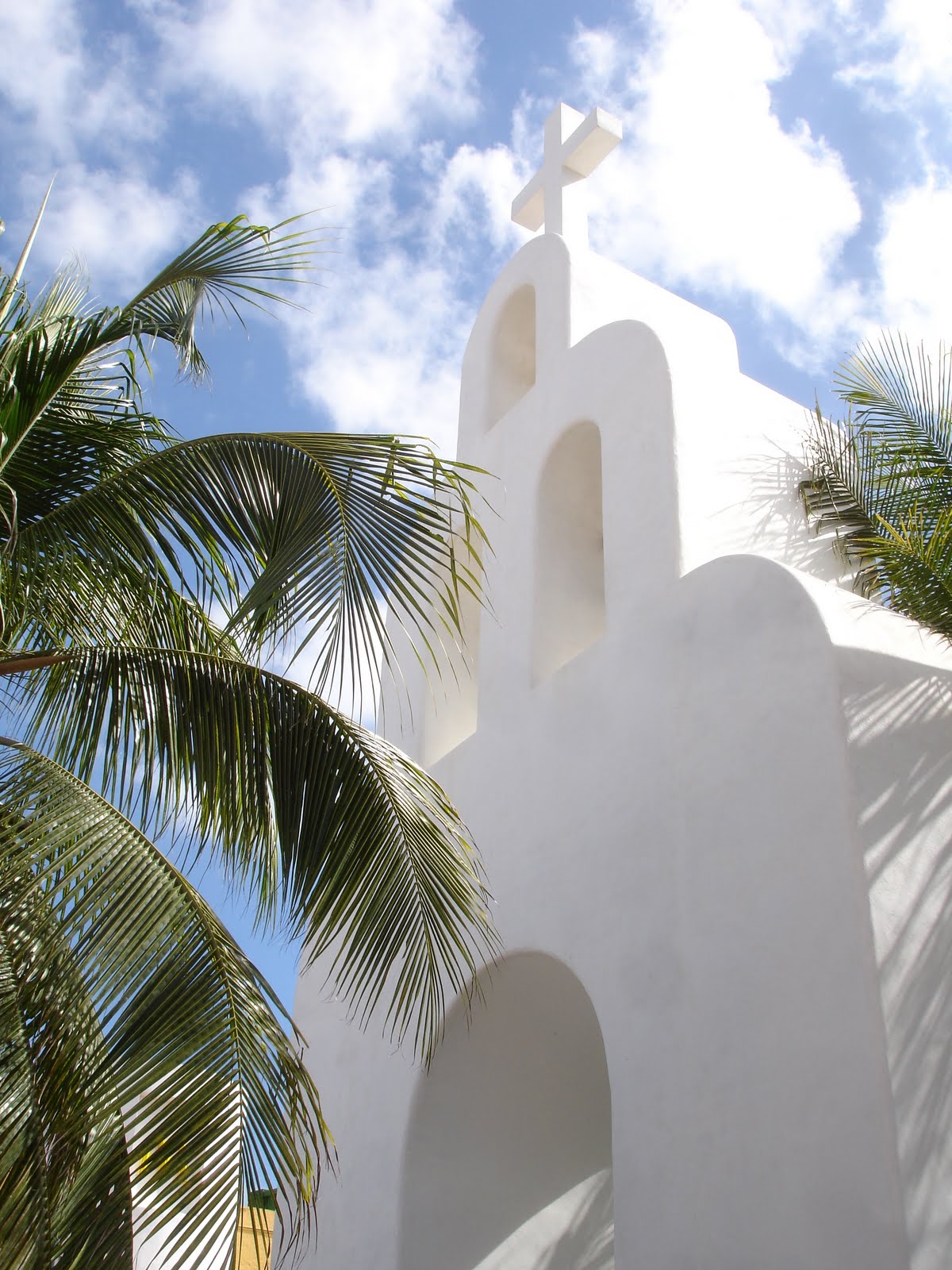
White is a very common color for houses of worship as well as homes. Think of the white chapels cluttering the American countryside. In Playa del Carmen, Mexico the steeple of this church raised our eyes from the bubbling colorful commerce of that tourist town, and toward the blue sky. That’s why we came so far south in February after all. Not to shop.


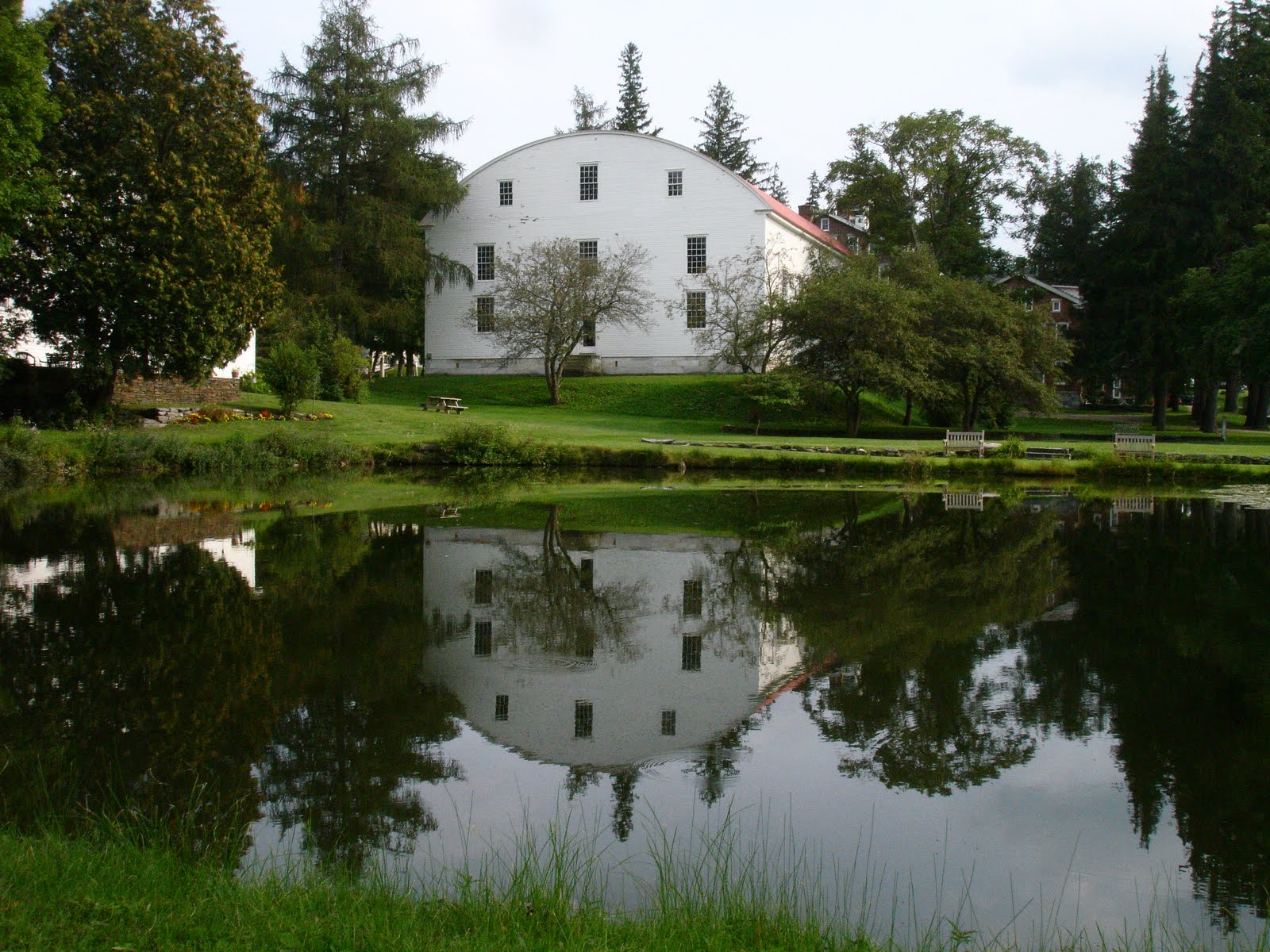
The Shakers did not shrink from painting buildings red, especially workshops and barns. But their dormitories and meeting houses were always a puritanical white. This meeting hall in New Lebanon, New York has the same moon-ascending quality as the little mosque outside my room in Delhi.


I took this picture from the top of the leaning tower on a winter afternoon in Pisa, looking west over the Duomo di Santa Maria Assunta. This cathedral; along with the other buildings of the Campo dei Miracoli, can blush like a school girl at sunset, but was sullen and ashen as a corpse under the low gray skies of March.


Augustine Hope, the co-author of The Color Compendium writes about the last century, “ I don’t think another century has its own color, but this one does. And that is white. White before this century was a luxury.” When I think of all the refridgerators, not to mention the billion or so other appliances, I can agree, the 20th century is white.White is modern and no one knew that better than the Bauhaus Group. They ushered in a rage for all things white in the early 30s. Maybe a reaction to the gloomy Great Depression? In this apartment house in Berlin the flatness of the white facade and the serious symmetry breaks into joy with the brightly colored door and windows. Once again white responding to its surrounding.


The interior of the entrance hall of the new wing of the Milwaukee Art Museum, not far from that 65th Street house where I grew up. This was Spanish architect, Santiago Calatrava’s first American project. Bauhaus member Johannes Itten said “form and color are one”, as far as the architecture of Calatrava is concerned I couldn’t agree more. His elegant air born buildings would look foolish in any thing but white.


The Marie-Elisabeth-Lueders-Haus, part of the modern government complex at the center of the reunified Berlin though modern in form has the beauty of ancient marble. The concrete surfaces were coated with a multifunctional scumble, a glaze for concrete and stone.


But all white buildings are not monuments, holy places or government building. More often they are homes. This small white house was built by my step-father and his father back in the 40s. I now belongs to my sister and I can’t imagine it being anything but white.


Even this humble little Mayan hut in Ekbalam, Mexico has a dignifying coat of white paint. Or maybe it’s just a practical heat deflecting coat of white paint.


Then there is home-sweet-home, white as sugar. Where I sleep and eat.
Where I write from.
Where the only monument, the only holy site, the only governance comes from a pale blue sky smeared with white clouds.